
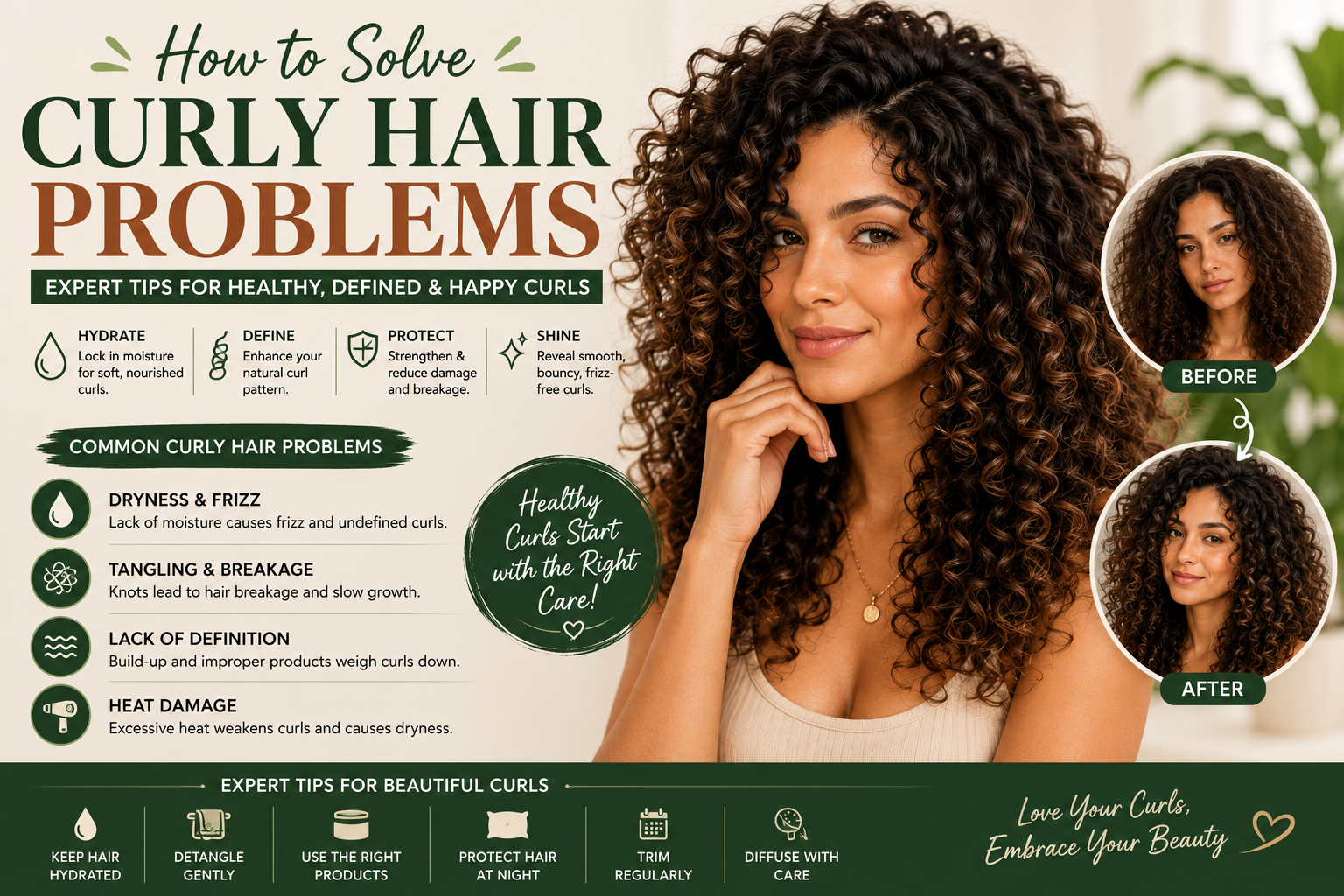
Managing curly hair can feel like a daily battle against texture and environmental elements. Many individuals struggle with frizz, dryness, and breakage without understanding the underlying causes. This comprehensive guide uncovers the root issues behind common curly hair problems and offers practical, expert backed strategies to help you achieve defined, healthy, and beautiful curls.
What Is Curly Hair Problems
Quick Definition
Curly hair problems refer to the unique challenges faced by individuals with wavy, curly, or coily hair textures due to structural differences in the hair shaft. These issues include intense dryness, frequent tangling, lack of definition, and vulnerability to damage, all stemming from how natural oils travel down the strands.
Detailed Explanation
To understand these issues, one must look at the biology of the scalp. The scalp produces a natural oil called sebum that protects and hydrates the hair. On straight hair, sebum easily travels from the root down to the tip. However, the twists, turns, and loops of curly patterns create physical barriers that prevent this oil from migrating downward. As a result, the mid lengths and ends of curly hair remain starved of natural hydration. This lack of moisture alters the cuticle layer, making the hair highly reactive to humidity and prone to friction.
Key Components
- Moisture imbalances within the hair shaft
- Cuticle lift caused by lack of lipid protection
- Structural weak points at every turn of the curl
- Porosity variations affecting hydration retention
Why Is Curly Hair Problems Important
User Benefits
Understanding your specific curl challenges allows you to select correct products and techniques. This saves money on ineffective treatments and drastically reduces styling time each morning.
Business Value
For salon professionals and product manufacturers, identifying these specific texture challenges drives innovation in clean formulations. It builds deep trust with clients who feel understood and properly cared for.
Practical Relevance
Properly addressing these concerns keeps your hair healthy and strong. It eliminates the frustration of unpredictable hair days and allows you to embrace your natural texture with complete confidence.
Current Industry Importance
The global beauty market is shifting toward celebrating natural textures. Consumers now demand specialized solutions free from harsh chemicals, making the study of curl health a top priority for dermatologists and stylists alike.
How Does Curly Hair Problems Work
Step 1 Understanding Porosity
Porosity determines how your hair absorbs and holds moisture. High porosity hair has gaps in the cuticle that let moisture in quickly but release it just as fast, while low porosity hair tightly resists water absorption.
Step 2 Tracking Moisture Loss
When curly hair lacks proper sealing, environmental air strips away internal water content. The dry hair strands then reach out to atmospheric moisture, causing the cuticles to lift and expand into frizz.
Step 3 Addressing Mechanical Friction
As dry curls rub against each other, or against harsh fabrics like cotton pillowcases, the raised cuticles interlock. This creates stubborn knots that lead to snapping and splitting during detangling.
Benefits of Managing Curly Hair Problems
Enhanced Definition
- What it is The clear formation of distinct curl patterns without fuzz.
- Why it matters It creates a polished look that lasts for multiple days.
- Expected outcome Bouncy curls that retain their shape from morning until night.
Maximum Moisture Retention
- What it is The ability of the hair strand to keep its hydration sealed inside.
- Why it matters It prevents the brittle texture that leads to structural damage.
- Expected outcome Soft, touchable hair that feels conditioned and healthy.
Reduced Breakage
- What it is The preservation of hair elasticity and strength.
- Why it matters It allows you to retain length and achieve thicker hair over time.
- Expected outcome Fewer split ends and significantly less shedding during wash days.
Challenges and Common Mistakes
Over Washing the Hair
- Problem Curls become excessively dry, coarse, and completely unmanageable.
- Cause Using clarifying shampoos too frequently strips away the sparse natural oils present on the scalp.
- Solution Limit shampooing to once or twice a week and utilize hydrating co washes instead.
Detangling When Dry
- Problem Extreme breakage, severe pain, and immediate loss of curl pattern.
- Cause Brushing dry curls tears through knots forcefully instead of gently separating them.
- Solution Only detangle your hair when it is completely saturated with a slippery conditioner during your shower.
Using Heavy Silicones
- Problem Hair becomes weighed down, dull, and experiences chronic buildup.
- Cause Non water soluble silicones coat the hair to hide frizz but block external moisture from entering.
- Solution Choose products containing natural oils and water soluble ingredients that wash away easily.
Best Practices and Expert Tips
- Apply styling products to soaking wet hair to lock in maximum water content.
- Use a microfiber towel or a clean cotton t shirt to gently squeeze out excess water.
- Protect your curls at night by sleeping on a silk or satin pillowcase.
- Utilize the pineapple method by tying hair loosely at the top of your head before bed.
- Incorporate a deep conditioning treatment into your routine every single week.
- Always use a heat protectant before utilizing a diffuser or any warm styling tools.
- Get regular trims every eight to twelve weeks to eliminate splitting ends.
- Apply a lightweight natural oil to seal the ends after applying your leave in conditioner.
- Avoid touching your curls while they are drying to prevent frizz from forming.
Comparison of Hair Care Approaches
Below is a comparison of two popular methods used to handle texture challenges.
Approach One: Traditional Care
- Focus: Heavy silicones and frequent heat styling
- Moisture Level: Low internal hydration with surface shine
- Long Term Health: Can lead to chronic dryness and structural thinning
Approach Two: Moisture Focused Care
- Focus: Botanical extracts and water soluble ingredients
- Moisture Level: High internal hydration and natural balance
- Long Term Health: Promotes elasticity, strength, and consistent curl definition
Frequently Asked Questions
Question Why does my curly hair always feel dry?
Direct Answer Curly hair feels dry because natural scalp oils cannot easily travel down the twisted shape of the strands. This leaves the lengths and ends without sufficient lubrication and protection.
Detailed Explanation The unique physical architecture of a curl creates bends that act as roadblocks for sebum. Without this natural coating, water evaporates rapidly from the core of the hair. To combat this, you must manually introduce moisture through hydrating creams and seal it with oils.
Question How can I stop my hair from frizzing in humidity?
Direct Answer You can stop frizz by ensuring your hair is fully hydrated before leaving the house and sealing it with an anti humidity gel.
Detailed Explanation Frizz occurs when dry hair cuticles expand to absorb moisture from the humid air. If you saturate the hair shaft with beneficial moisture and seal it with a strong hold gel during your styling routine, the hair will not react to external environmental humidity.
Question What is the best way to detangle stubborn knots?
Direct Answer The best way to detangle is to do it during the conditioning step of your wash routine using a wide tooth comb or your fingers.
Detailed Explanation Never attempt to brush curly hair when it is dry. The lubrication provided by a high slip conditioner coats the strands, allowing knots to slide apart without snapping the hair fibers. Always start detangling from the ends and slowly work your way up to the roots.
Question How often should I wash curly hair?
Direct Answer Most curly individuals find that washing their hair one to two times per week is ideal for maintaining balance.
Detailed Explanation Washing too often strips away the precious oils that keep curls supple. If your scalp feels dirty between washes, try rinsing with water alone or using a specialized cleansing conditioner to refresh your style without removing moisture.
Question Can split ends be repaired without cutting?
Direct Answer No, split ends cannot be permanently repaired and must be cut off to prevent further damage.
Detailed Explanation While some products can temporarily bond split ends together for a single wash, the physical split will eventually travel up the hair shaft. Regular trims are the only way to maintain healthy hair architecture.
Question What is the difference between hair shedding and breakage?
Direct Answer Shedding is a natural biological process where the hair falls from the root, while breakage is structural snapping along the shaft.
Detailed Explanation It is normal to shed around one hundred hairs per day. You can identify shedding by looking for a small white bulb at the root end of the hair. Breakage results in short, jagged pieces and indicates that your hair needs more moisture or protein.
Question Should I use protein or moisture for my curls?
Direct Answer Your hair needs a balanced combination of both protein to provide structure and moisture to ensure flexibility.
Detailed Explanation If your hair feels mushy and stretches without returning to its shape, it requires protein. If it feels brittle, rough, and snaps easily, it is craving intense moisture. Pay attention to how your hair responds to find the perfect equilibrium.
Question How do I protect my curls while sleeping?
Direct Answer You can protect your curls by gathering them loosely at the top of your head and sleeping on satin fabrics.
Detailed Explanation Cotton pillowcases create intense friction that saps moisture and disrupts the curl pattern. Switching to a satin pillowcase or wearing a silk bonnet allows your hair to glide smoothly, preserving your style for the next morning.
Key Takeaways
- Curly hair dryness is a structural issue caused by natural oils failing to reach the ends.
- Moisture must be manually introduced and sealed using water soluble products.
- Detangling should only occur on wet hair that is saturated with conditioner.
- Protecting hair at night with silk or satin preserves curl definition and prevents frizz.
Final Verdict
Managing curly hair problems requires moving away from generic hair care habits and adopting a moisture first philosophy. By understanding your porosity and respecting the fragile nature of your curl pattern, you can eliminate frizz and breakage permanently. Consistency is your greatest asset on this journey.
Conclusion
Navigating curly hair problems does not have to be an endless source of frustration. By understanding how porosity, hydration, and friction impact your strands, you can build a simple routine that delivers consistent results. The next step is to evaluate your current product lineup and remove any harsh drying agents. Embracing your natural texture with the right knowledge will transform your hair health completely.