
✔ What makes curly hair different?
✔ How to identify your curly curl type
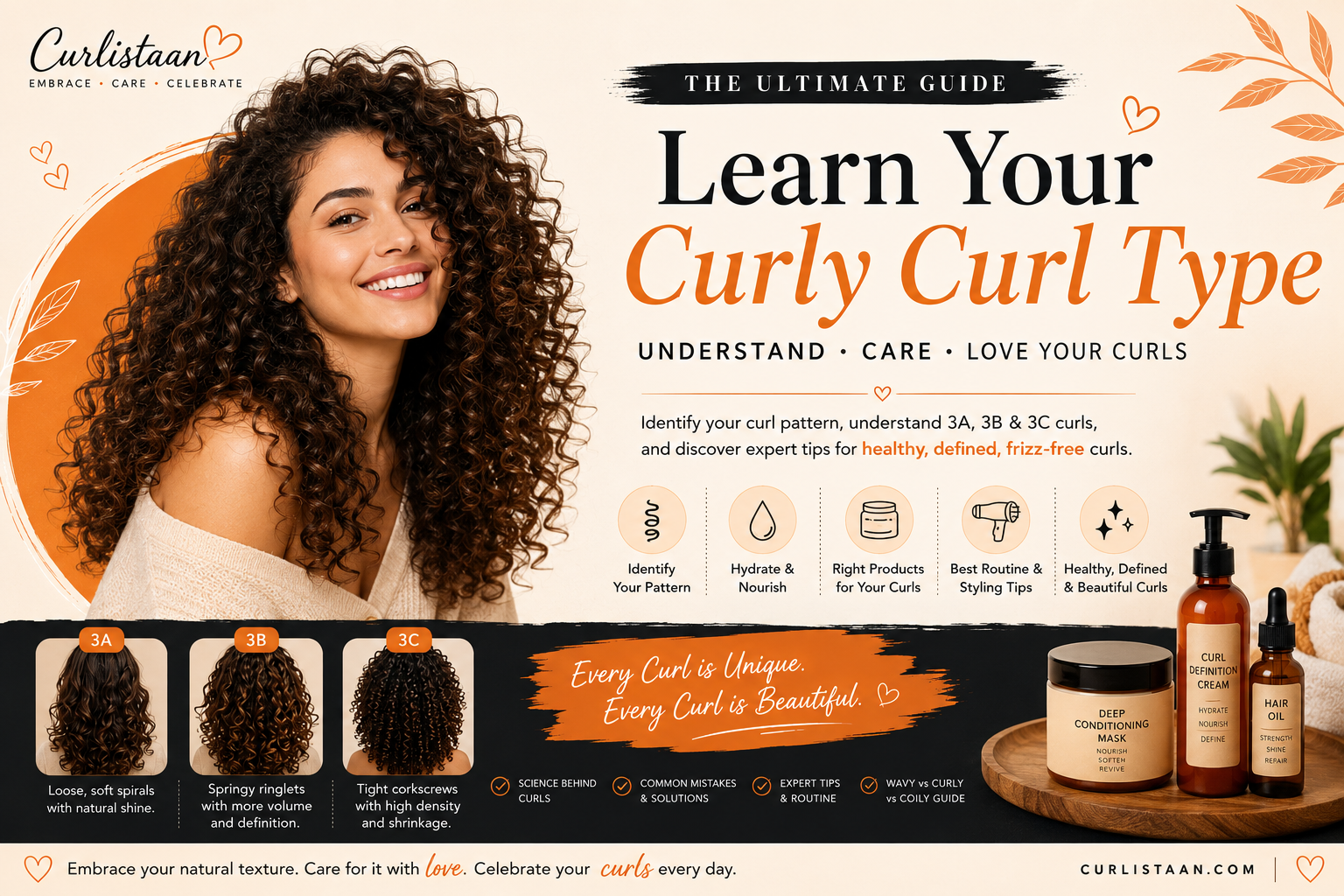
✔ Understanding Types 3A, 3B & 3C curls
✔ Common curly hair myths
✔ Why your curls behave differently every day
✔ Essential products every curly-haired person should own
Every Curl Tells a Story—What’s Yours?
Some curls bounce effortlessly with every step, while others form tight spirals that seem to have a personality of their own. If you’ve ever stood in front of the mirror wondering why your hair reacts differently to every product, weather change, or styling technique, you’re not alone.
The truth is, curly hair isn’t one-size-fits-all.
One person’s holy-grail curl cream may leave another person’s curls weighed down. A routine that works perfectly for loose curls may not suit tighter ringlets at all. That’s why understanding your natural curl pattern is the foundation of healthy hair care.
Welcome to another Curly Hair Blog from Curlistaan, where we simplify curly hair care with practical, science-backed guidance. In this guide, you’ll discover how to identify your curly curl type, understand the differences between 3A, 3B, and 3C curls, and learn how to care for them in a way that enhances their natural beauty instead of fighting against it.
By the end of this article, you’ll be able to build a routine that’s designed for your curls—not someone else’s.
What Exactly Are Curly Curls?
Quick Answer
Curly curls belong to Type 3 hair, characterized by well-defined spirals or ringlets that naturally bounce and spring back into shape. They sit between loose waves and tightly coiled hair, offering impressive volume, texture, and movement while requiring balanced moisture and frizz control.
Understanding Curly Hair Beyond the Basics
Curly hair is more than just a hairstyle—it’s the natural shape your hair grows into.
Unlike straight strands that grow from nearly round follicles, curly hair develops from slightly oval or asymmetrical follicles. This unique structure causes each strand to bend naturally, creating spirals or corkscrew curls.
The tighter the bend, the curlier the hair becomes.
One of the most fascinating things about curly hair is that no two heads of curls are exactly alike. Even within the same family, curl patterns can vary dramatically.
You may notice that:
- The front pieces are looser.
- The crown has tighter curls.
- The underneath section looks completely different.
This is completely normal.
Rather than trying to make every strand look identical, the goal is to understand how your curls naturally behave and support them with the right routine.
Meet the Type 3 Curl Family
Not every curly head looks the same.
Curly hair is generally divided into three subtypes, each with its own personality and care requirements.
3A Curls — Soft, Loose Spirals
Quick Answer
3A curls are large, loose spirals with natural shine and movement. They usually require lightweight products that define curls without making them feel heavy.
What Makes 3A Unique?
Think of wide ribbon-like curls that spring back when stretched.
People with 3A curls often enjoy:
- Soft bounce
- Easy movement
- Visible curl definition
- Less shrinkage than tighter curls
However, they may also experience:
- Flat roots
- Humidity-related frizz
- Loss of definition by the end of the day
The best approach is using lightweight curl creams and mousse instead of thick butters.
3B Curls — Springy Ringlets
Quick Answer
3B curls form tighter, more voluminous ringlets that naturally create fullness. They thrive with moisturizing products that maintain elasticity while reducing frizz.
What Makes 3B Different?
These curls resemble spring-like corkscrews.
Characteristics include:
- Medium-sized ringlets
- High natural volume
- Noticeable frizz in humid weather
- Better curl memory
Because of their density, 3B curls often need richer leave-in conditioners than 3A curls.
3C Curls — Tight Corkscrews
Quick Answer
3C curls are densely packed corkscrew curls that sit between curly and coily hair. They require consistent hydration to maintain softness, definition, and elasticity.
Why They’re Special
3C curls create incredible volume.
They’re known for:
- Tight spring-like curls
- Dense texture
- High shrinkage
- Excellent styling versatility
Although they appear thick, individual strands are still delicate and benefit from gentle handling.
📷 Insert Image 2 Here
Image Title
3A vs 3B vs 3C Curly Hair
File Name
3a-3b-3c-curly-hair-guide.webp
ALT Text
Comparison of Type 3A, Type 3B and Type 3C curly hair patterns.
Why Understanding Your Curl Type Changes Everything
Quick Answer
Knowing your curl type helps you choose products, styling methods, and routines that match your hair’s natural needs. It saves time, reduces product waste, and supports healthier, more manageable curls.
Imagine buying the most popular curl cream online.
Thousands of five-star reviews.
Everyone loves it.
But after applying it, your curls feel sticky and lifeless.
Was the product bad?
Probably not.
It simply wasn’t formulated for your curl pattern.
This is one of the biggest mistakes people make.
Instead of understanding their natural texture, they copy routines from influencers whose curls behave completely differently.
When you know your curl type, you can:
- Shop smarter.
- Wash with confidence.
- Reduce unnecessary breakage.
- Improve curl definition.
- Build a routine that actually works.
Healthy curls don’t come from expensive products.
They come from informed choices.
The Science Behind Curly Hair
Quick Answer
Curly hair forms because of the shape of the hair follicle and the uneven distribution of keratin within each strand. These structural differences create natural bends that form spirals instead of straight strands.
Think of your hair strand like a ribbon.
If you gently pull one side tighter than the other, the ribbon begins to curl.
Hair behaves similarly.
Curved follicles and uneven protein distribution naturally create spiral shapes.
Because curls twist around themselves:
- Natural oils travel more slowly.
- Moisture escapes faster.
- Frizz develops more easily.
- Gentle care becomes essential.
This is why curly hair often requires hydration more frequently than straight hair.
Signs You Naturally Have Curly Hair
You probably have Type 3 curls if you notice these characteristics:
✔ Hair forms spirals without heat styling.
✔ Your curls bounce back after stretching.
✔ Humidity increases frizz.
✔ Dry brushing creates puffiness instead of smoothness.
✔ Curl definition improves when hair is wet.
✔ Lightweight styling products work better than heavy waxes.
✔ Your hair appears shorter after drying because of natural shrinkage.
Curly Hair Myths That Need to Go
Many misconceptions stop people from embracing their natural curls.
Myth 1
Curly hair is always difficult to manage.
Reality:
With the right routine, curly hair becomes predictable and easier to style.
Myth 2
Brushing dry curls makes them healthier.
Reality:
Dry brushing separates curl clumps and creates unnecessary frizz.
Myth 3
More products mean better curls.
Reality:
Layering too many products often leads to buildup and dull-looking curls.
Myth 4
Frizz means unhealthy hair.
Reality:
A little frizz is completely natural—especially in humid weather. The goal isn’t perfectly “frizz-free” hair, but healthy, hydrated curls with manageable definition.
Benefits of Understanding Your Curly Curl Type
Quick Answer
Learning your curly curl type helps you create a routine tailored to your hair’s natural needs. It improves curl definition, reduces breakage, prevents product overload, and makes styling easier. Instead of guessing what works, you can confidently choose products and techniques that bring out your curls’ best texture.
Why It Matters
Curly hair is naturally beautiful, but it responds differently depending on its curl pattern. Once you understand whether your curls are 3A, 3B, or 3C, every step of your routine becomes more intentional—and the results become more consistent.
1. Better Curl Definition
Using products suited to your curl type enhances your natural pattern without making it stiff or crunchy.
Expected Outcome: Well-defined, bouncy curls that last longer.
2. Less Frizz
Frizz often appears when curly hair lacks moisture or the wrong styling products are used.
Expected Outcome: Softer curls with better moisture retention.
3. Healthier Hair
Understanding your curls helps you avoid habits that cause damage, such as brushing dry hair or overusing heat tools.
Expected Outcome: Reduced breakage and stronger strands.
4. Easier Styling
Knowing your curl pattern makes it easier to choose hairstyles and styling methods that actually suit your texture.
Expected Outcome: Faster styling with more predictable results.
5. Smarter Product Choices
Instead of buying every trending product, you learn which ingredients and formulas actually benefit your curls.
Expected Outcome: Save money while building an effective routine.
📷 Insert Image 5 Here
Image Title
Benefits of Knowing Your Curl Type
File Name
benefits-of-curly-hair-guide.webp
ALT Text
Woman with healthy defined curly hair highlighting the benefits of understanding curl type.
Common Challenges (And How to Fix Them)
Quick Answer
Most curly hair concerns—such as frizz, dryness, or lack of definition—can be improved with the right routine. Understanding the cause behind each problem helps you choose effective solutions instead of relying on trial and error.
| Challenge | Why It Happens | Solution |
|---|---|---|
| Frizz | Hair lacks moisture | Use a leave-in conditioner and curl cream |
| Dry Ends | Natural oils don’t reach the tips easily | Deep condition weekly |
| Flat Roots | Heavy styling products | Use lightweight mousse near the roots |
| Product Build-up | Too many products | Clarify once every month |
| Breakage | Rough towel drying and brushing | Use a microfiber towel and wide-tooth comb |
| Undefined Curls | Wrong styling method | Style on soaking wet hair |
Expert Tips for Beautiful Curly Hair
Small changes often make the biggest difference. Follow these expert-approved practices to keep your curls healthy and manageable.
1. Cleanse Without Stripping
Choose a gentle, sulfate-free shampoo that removes dirt while preserving your hair’s natural moisture.
2. Never Skip Conditioner
Conditioner helps smooth the hair cuticle, making curls softer, shinier, and easier to detangle.
3. Style While Hair Is Wet
Applying styling products to soaking wet hair helps lock in moisture and encourages better curl formation.
4. Scrunch Instead of Brushing
Use your hands to gently scrunch products into your curls rather than brushing them through.
5. Deep Condition Every Week
A weekly deep conditioning treatment restores hydration and improves elasticity.
6. Protect Your Hair While Sleeping
Sleep on a satin pillowcase or wear a satin bonnet to reduce friction and preserve curl definition.
7. Limit Heat Styling
Frequent use of straighteners or curling irons can weaken the curl pattern over time.
8. Refresh Instead of Rewashing
A water spray mixed with leave-in conditioner can revive second- or third-day curls without washing.
9. Trim Regularly
Removing split ends every 10–12 weeks helps maintain healthy-looking curls.
10. Be Consistent
Healthy curls develop through a consistent routine—not overnight transformations.
📷 Insert Image 6 Here
Image Title
Healthy Curly Hair Routine
File Name
curly-hair-routine-guide.webp
ALT Text
Step-by-step curly hair care routine showing washing, conditioning, styling, and protecting curls.
Comparison Table: Wavy vs Curly vs Coily Hair
| Feature | Wavy Hair | Curly Hair | Coily Hair |
|---|---|---|---|
| Pattern | Soft S-shaped waves | Defined spirals | Tight coils or zigzags |
| Volume | Moderate | High | Very High |
| Frizz | Moderate | High | High |
| Moisture Needs | Medium | High | Very High |
| Shrinkage | Low | Moderate | Significant |
| Styling Time | Short | Medium | Longer |
| Best Products | Lightweight | Moisturizing | Rich creams & butters |
Frequently Asked Questions
1. What is considered curly hair?
Direct Answer:
Curly hair belongs to the Type 3 category and naturally forms spirals or ringlets instead of lying straight. It ranges from loose 3A curls to tighter 3C corkscrews.
Detailed Explanation:
Each subtype has unique moisture and styling needs, making it important to identify your exact curl pattern.
2. How can I identify my curly curl type?
Direct Answer:
Wash your hair, avoid brushing it, let it air dry, and observe your natural pattern. Loose spirals are usually 3A, springy ringlets are 3B, and tighter corkscrews are 3C.
3. Why does curly hair become frizzy?
Direct Answer:
Curly hair loses moisture more quickly than straight hair, causing the outer layer to lift and create frizz.
4. How often should curly hair be washed?
Direct Answer:
Most curly hair benefits from washing every 5–7 days, depending on scalp health, product use, and lifestyle.
5. Which ingredients are best for curly hair?
Direct Answer:
Look for aloe vera, shea butter, glycerin, argan oil, coconut oil, and protein-rich conditioners.
6. Can curly hair become straight naturally?
Direct Answer:
No. Your natural curl pattern is determined by genetics, although hormones, heat damage, or chemical treatments can temporarily alter its appearance.
7. Is frizz always a sign of damaged hair?
Direct Answer:
Not necessarily. Some frizz is completely normal, especially in humid weather. Excessive dryness or damage, however, can increase frizz.
8. What’s the biggest mistake curly-haired people make?
Direct Answer:
Using products or routines meant for someone else’s curl type instead of understanding their own hair’s needs.
Key Takeaways
- Curly hair belongs to the Type 3 curl family.
- 3A, 3B, and 3C curls all have different care requirements.
- Moisture is the key to healthy, defined curls.
- Avoid brushing curls when they’re dry.
- Style your hair while it’s wet for better definition.
- Deep conditioning improves elasticity and softness.
- Satin accessories help reduce friction and frizz.
- Consistency always delivers better results than constantly changing products.
Final Verdict
Curly hair isn’t difficult—it’s simply different. Once you understand your curl pattern, caring for your hair becomes less about following trends and more about choosing what truly works for your unique texture.
Whether you have loose 3A spirals, springy 3B ringlets, or tightly packed 3C curls, embracing your natural pattern is the first step toward healthier, more confident hair.
Conclusion
Every curl has its own personality, and learning to work with it rather than against it makes all the difference. This Curly Hair Blog has explored how to identify Type 3 curls, understand the differences between 3A, 3B, and 3C, and build a routine that supports healthier, more defined Curly Hair.
Remember, there isn’t a single “perfect” curly hair routine. The best routine is the one that matches your unique curl pattern, keeps your hair hydrated, and fits your lifestyle. Start with small changes, stay consistent, and let your natural curls shine.