Have you ever wondered why some curls form tight zigzags while others create soft spirals? Understanding your curl pattern is the first step toward healthier, more manageable hair. If you’ve been trying products that never seem to work, there’s a good chance you haven’t identified your true curl type yet.
This Curly hair blog is designed to help you understand one of the most unique curl patterns—coily curls. Coily hair is naturally beautiful, but it requires specific care because of its tight curl pattern, delicate structure, and tendency to lose moisture quickly.
Whether you’re just beginning your curly hair journey or looking to improve your current routine, this guide will help you identify coily curls, understand their needs, and learn practical tips to keep them healthy, soft, and defined.
What Is Coily Curl?
Quick Definition
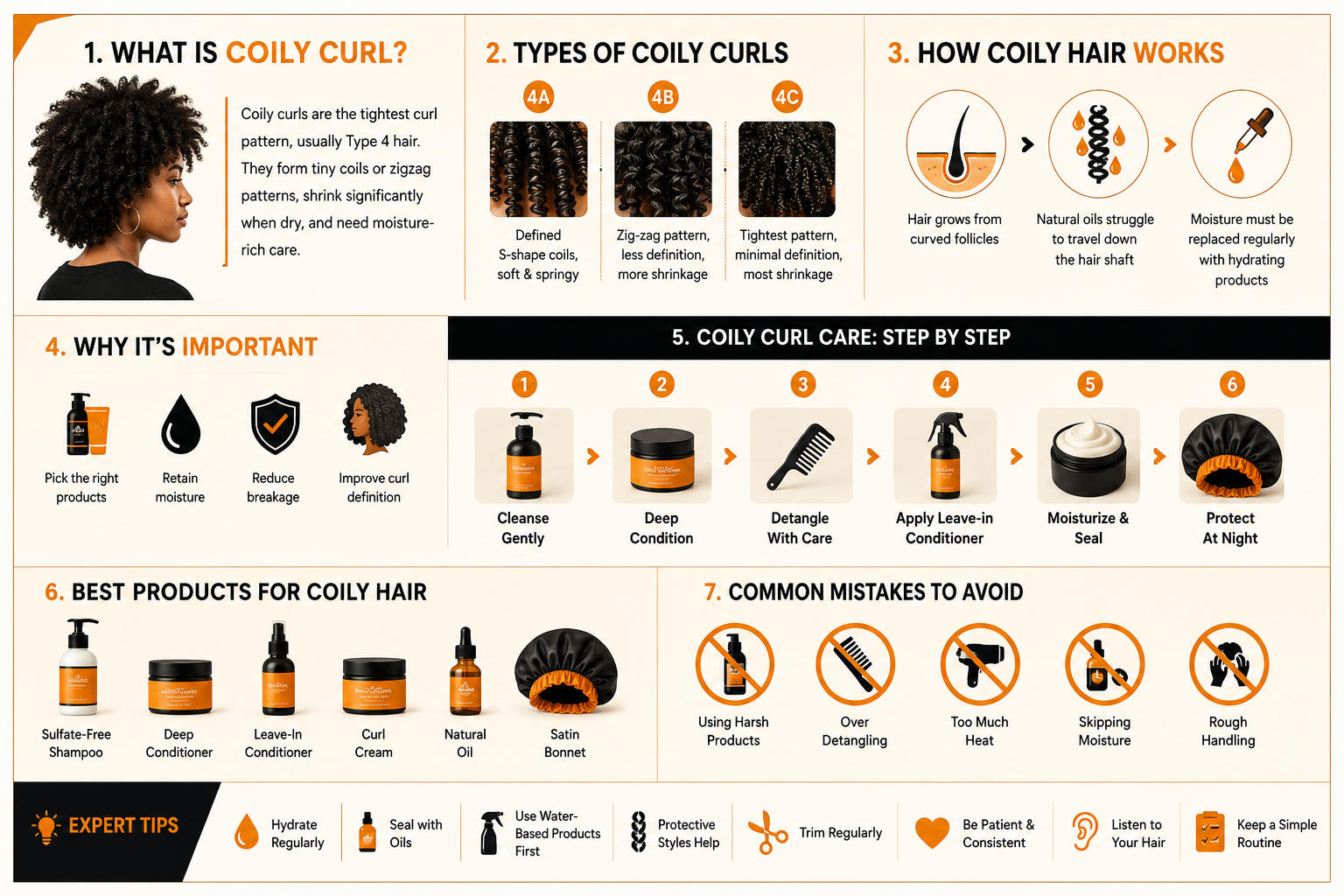
Coily curls are the tightest curl pattern, usually classified as Type 4 hair. They form very small coils or zigzag patterns, shrink significantly when dry, and need consistent moisture to remain healthy. Despite appearing short, coily hair can have impressive length when stretched.
Detailed Explanation
Coily hair belongs to the Type 4 category in the widely accepted curl classification system developed by hairstylist Andre Walker. Instead of forming loose spirals, coily strands create tight coils or sharp bends.
One of the defining characteristics of coily hair is shrinkage. Hair that reaches shoulder length when stretched may appear only ear-length naturally. This is completely normal and doesn’t indicate slow hair growth.
Another unique feature is its natural dryness. The scalp produces natural oils, but because of the tight bends in each strand, those oils struggle to travel from the roots to the ends. As a result, coily hair often feels dry and requires regular hydration.
Although coily hair is delicate, it is incredibly versatile. It can be styled into twist-outs, braid-outs, wash-and-go styles, protective hairstyles, afros, and many other beautiful looks while maintaining its natural texture.
Key Characteristics of Coily Hair
- Tight coils or zigzag curl pattern
- Significant shrinkage
- Naturally dry texture
- High volume
- Fragile strands
- Prone to tangling
- Loves moisture-rich products
- Requires gentle handling
- Highly versatile styling options
Why Is Learning Your Coily Curl Type Important?
Direct Answer
Knowing your coily curl type helps you choose suitable products, create an effective routine, reduce breakage, retain moisture, and improve curl definition. It also prevents wasting money on products designed for other hair textures.
Detailed Explanation
Many people assume all curly hair behaves the same, but each curl pattern has different needs.
When you understand your coily curls, you can:
- Select shampoos that cleanse without stripping moisture.
- Choose conditioners rich in nourishing ingredients.
- Avoid heavy brushing that causes unnecessary breakage.
- Build a wash routine that works specifically for tightly coiled hair.
- Maintain healthier hair over time.
Learning your curl type also helps you set realistic expectations. Coily hair naturally shrinks, tangles more easily, and requires patience. Accepting these characteristics allows you to care for your hair instead of constantly trying to change it.
Types of Coily Curls
Coily hair is generally divided into three categories.
Type 4A
Type 4A curls have clearly defined, spring-like coils about the size of a crochet needle.
Characteristics:
- Soft texture
- Visible curl definition
- Responds well to curl creams
- Retains moisture better than other Type 4 patterns
Ideal products include:
- Leave-in conditioners
- Curl creams
- Lightweight oils
Type 4B
Type 4B hair forms sharp “Z”-shaped bends rather than round coils.
Characteristics:
- Less visible curl definition
- More shrinkage
- Extremely soft
- Higher risk of dryness
Recommended products:
- Rich moisturizers
- Cream-based leave-ins
- Deep conditioners
Type 4C
Type 4C hair has the tightest curl pattern and the greatest amount of shrinkage.
Characteristics:
- Dense texture
- Minimal visible curl definition
- Very fragile
- Requires intensive moisture
Best products:
- Thick creams
- Butters
- Deep conditioning masks
- Protective styling products
How Does Coily Hair Work?
Direct Answer
Coily hair grows from curved follicles, creating tight curls or zigzag bends. These bends make it difficult for natural scalp oils to travel down the hair shaft, leading to dryness and increased fragility.
Step 1: Hair Grows from Curved Follicles
Unlike straight hair, coily hair grows from curved follicles. This natural shape determines the tight curl pattern.
Step 2: Natural Oils Move Slowly
Sebum produced by the scalp has difficulty reaching the ends because of the many twists and bends in the hair strand.
The ends become dry much faster than the roots.
Step 3: Moisture Must Be Replaced
Since natural oils cannot coat the hair evenly, coily hair benefits from regular conditioning, leave-in products, and sealing oils.
For example, after washing, applying a leave-in conditioner followed by a lightweight oil and a curl cream helps lock moisture into the strands for several days.
Common Signs You Have Coily Hair
If you’re unsure whether your hair is coily, check these signs:
- Your curls shrink by more than 50% after drying.
- Your hair feels dry shortly after washing.
- Curl strands are tightly packed.
- Detangling requires patience.
- Your hair has incredible volume.
- Protective hairstyles last well.
- Moisture-rich products make a noticeable difference.
- Twist-outs and braid-outs create beautiful definition.
Common Myths About Coily Hair
Myth 1: Coily Hair Doesn’t Grow
Truth: Coily hair grows at a normal rate. Shrinkage simply hides its true length.
Myth 2: Coily Hair Is Always Strong
Truth: While it looks thick, each strand is actually delicate and prone to breakage if handled roughly.
Myth 3: Oils Moisturize Hair
Truth: Oils seal existing moisture but don’t hydrate dry hair on their own. Water and conditioners provide hydration.
Myth 4: Coily Hair Should Be Shampooed Rarely
Truth: A clean scalp is essential for healthy hair growth. Gentle cleansing on a suitable schedule is healthier than avoiding shampoo altogether.
Essential Products for Coily Hair
Choosing the right products can make caring for coily curls much easier.
Look for:
- Sulfate-free shampoo
- Moisturizing conditioner
- Deep conditioning treatment
- Leave-in conditioner
- Curl cream
- Lightweight oils
- Satin bonnet or pillowcase
- Wide-tooth comb
- Microfiber towel
- Spray bottle for refreshing curls
These products help maintain hydration, reduce friction, and support healthier-looking curls over time.
Benefits of Coily Hair
Direct Answer
Coily hair is naturally voluminous, versatile, and protective. With the right care routine, it can retain length, reduce breakage, and showcase beautifully defined curls. Understanding your coily curl pattern allows you to work with your hair instead of against it.
Detailed Explanation
Coily hair is often misunderstood because of its shrinkage and unique texture. However, it offers several advantages that make it truly special.
1. Incredible Volume
Coily curls naturally create fullness, giving your hair a thicker appearance without needing styling tools.
2. Endless Styling Options
From wash-and-go looks to twist-outs, braid-outs, Bantu knots, afros, and protective styles, coily hair is incredibly versatile.
3. Better Protective Styling
Braids, twists, wigs, and protective hairstyles hold exceptionally well on coily hair, helping retain length.
4. Unique Natural Texture
Every coily curl pattern is different, making your hair beautifully unique.
5. Improved Hair Health
Following a moisture-focused routine leads to softer curls, reduced breakage, and healthier-looking hair over time.
Challenges and Common Mistakes
Direct Answer
Most coily hair problems result from dryness, rough handling, and using unsuitable products. Understanding these challenges helps prevent unnecessary damage and keeps curls healthy.
| Problem | Cause | Solution |
|---|---|---|
| Dry hair | Lack of moisture | Deep condition weekly and use leave-in conditioner |
| Breakage | Rough detangling | Detangle only on damp, conditioned hair |
| Excessive frizz | Moisture loss | Seal moisture with a lightweight oil or butter |
| Product buildup | Heavy styling products | Clarify once every 3–4 weeks |
| Split ends | Skipping trims | Trim every 10–12 weeks |
| Scalp irritation | Infrequent cleansing | Use a gentle sulfate-free shampoo regularly |
Best Practices and Expert Tips
Direct Answer
Healthy coily curls thrive on moisture, gentle handling, and consistency. A simple routine followed regularly delivers better results than constantly switching products.
10 Expert Tips
- Wash your scalp regularly using a sulfate-free shampoo.
- Deep condition at least once every week.
- Detangle only on wet, conditioned hair.
- Apply leave-in conditioner immediately after washing.
- Seal moisture using jojoba oil, argan oil, or shea butter.
- Sleep on a satin pillowcase or wear a satin bonnet.
- Avoid excessive heat styling.
- Trim damaged ends every few months.
- Choose water-based moisturizing products.
- Stay consistent—healthy curls take time, not overnight miracles.
Comparison Table: Coily Hair vs Curly Hair
| Feature | Coily Hair | Curly Hair |
|---|---|---|
| Curl Pattern | Tight coils or zigzags | Loose to medium spirals |
| Shrinkage | High (50–80%) | Moderate |
| Moisture Needs | Very High | Moderate |
| Frizz Level | High if dry | Moderate |
| Curl Definition | Depends on hydration | Naturally visible |
| Breakage Risk | Higher | Moderate |
| Styling Time | Longer | Shorter |
| Protective Styles | Excellent | Good |
Frequently Asked Questions (FAQs)
1. What is coily hair?
Direct Answer:
Coily hair is a Type 4 curl pattern with tight coils or zigzag strands. It naturally experiences significant shrinkage and needs consistent moisture to stay healthy.
Detailed Explanation:
Coily hair ranges from 4A to 4C and is known for its dense texture, delicate strands, and beautiful volume.
2. How do I know if I have coily hair?
Direct Answer:
If your hair forms tight coils, shrinks significantly after drying, and becomes dry quickly, you most likely have coily hair.
Detailed Explanation:
Observing your natural pattern after washing is the easiest way to identify your curl type.
3. Why is coily hair always dry?
Direct Answer:
Natural scalp oils cannot easily travel through tightly coiled strands, leaving the ends drier than the roots.
Detailed Explanation:
Regular hydration and sealing products help compensate for this natural characteristic.
4. How often should coily hair be washed?
Direct Answer:
Most people benefit from washing coily hair every 7–14 days, depending on their lifestyle, scalp condition, and product usage.
Detailed Explanation:
Keeping the scalp clean supports healthy hair growth while avoiding excessive dryness.
5. Is coily hair stronger than straight hair?
Direct Answer:
Although coily hair appears thick, individual strands are often more fragile because of their tight bends.
Detailed Explanation:
Gentle handling reduces breakage and preserves length.
6. Can coily hair grow long?
Direct Answer:
Yes. Coily hair grows at the same average rate as other hair types, but shrinkage often hides its actual length.
Detailed Explanation:
Healthy routines and protective styling help retain visible length.
7. Which ingredients work best for coily hair?
Direct Answer:
Look for aloe vera, glycerin, shea butter, jojoba oil, coconut oil, and nourishing conditioners.
Detailed Explanation:
These ingredients improve moisture retention and reduce dryness.
8. What’s the biggest mistake people make with coily hair?
Direct Answer:
Treating coily hair like straight hair is the most common mistake.
Detailed Explanation:
Using harsh shampoos, dry brushing, or skipping conditioner often causes breakage and frizz.
Key Takeaways
- Coily hair belongs to the Type 4 curl family.
- It naturally experiences significant shrinkage.
- Moisture is the foundation of healthy coily curls.
- Deep conditioning should be part of every routine.
- Gentle detangling reduces breakage.
- Protective hairstyles support length retention.
- Satin accessories help reduce friction.
- Consistency produces the best long-term results.
Final Verdict
Coily hair is one of the most beautiful and versatile natural hair textures, but it requires intentional care. Understanding whether you have 4A, 4B, or 4C hair helps you choose suitable products and create a routine that works for your specific curl pattern.
Rather than trying to change your natural texture, focus on keeping it hydrated, protected, and healthy. Small, consistent habits will always deliver better results than chasing quick fixes.
Conclusion
Learning your curl type is the first step toward healthier, happier curls. This Curly hair blog has shown that coily hair is unique, beautiful, and deserving of specialized care. By understanding your curl pattern, following a moisture-rich routine, and avoiding common mistakes, you can enjoy stronger, softer, and more defined Curly hair.
If you’re beginning your natural hair journey, start with simple changes—identify your curl type, invest in quality moisturizing products, and stay consistent. Your curls will thank you.